


23th October, 2026
A Q&A with Jack Briggs of Intersect MBO

By Joe Pan
SINGAPORE — Across the crowded exhibition halls of Token 2049, the digital asset industry’s executive dialogue has shifted perceptibly away from speculative retail narratives toward the structural plumbing required for long-term institutional survival. As regulatory initiatives stall in Washington—evidenced by the legislative friction surrounding the U.S. Digital Asset Market CLARITY Act—global infrastructure builders are confronting two technological milestones that cannot be delayed by political inertia: the rapid approach of Post-Quantum Day (PQD) and the unchecked proliferation of autonomous, machine-driven commerce.
Few executives occupy a more vantage-rich position on these converging frontiers than Jack Briggs, Executive Director of Intersect MBO. A former commercial strategist at Three UK and Vodafone UK who later steered product marketing for Cardano’s “Voltaire” governance era at Input Output Global (IOG), Briggs today oversees an ecosystem treasury exceeding $325 million.
Briggs’ mandate operates at the center of an operational and institutional evolution across the Cardano ecosystem. Under the Voltaire governance architecture, absolute decision-making power has decentralized into on-chain voting by Delegated Representatives (DReps) on behalf of ADA holders, subject to constitutional parameters enforced by an elected Constitutional Committee. In this model, the Cardano Foundation continues its dedicated institutional role—spearheading enterprise adoption, regulatory engagement, network health, and protocol advocacy—while Intersect MBO functions as the open-source administrative engine. Intersect coordinates member-led working groups, procures technical deliverables, and ensures that community-approved funding translates into transparent, milestone-gated progress.
That capital allocation engine is now confronting a shrinking technological horizon. While legacy financial rails and older Layer-1 blockchains operate under the comfortable assumption that quantum decryption remains decades away, Briggs warns that the timeline has collapsed. Driven by explosive advances in frontier artificial intelligence models and high-performance supercomputing, the threat window has accelerated toward the early 2030s.
Over the past 18 months, the Cardano treasury has deployed more than 800 million ADA into infrastructure, ecosystem growth, and network resilience. Most recently, the community approved an allocation of approximately 32.9 million ADA (roughly $9 million USD) to fund Input Output Research’s 2026 program, dedicating significant engineering resources directly to quantum-resistant cryptography and the future evolution of Cardano’s Ouroboros consensus mechanism. Simultaneously, the network is deploying privacy-preserving infrastructure via Midnight and machine-to-machine coordination rails through projects like Masumi to ensure autonomous AI agents can transact without leaking enterprise secrets or exceeding delegated mandates.
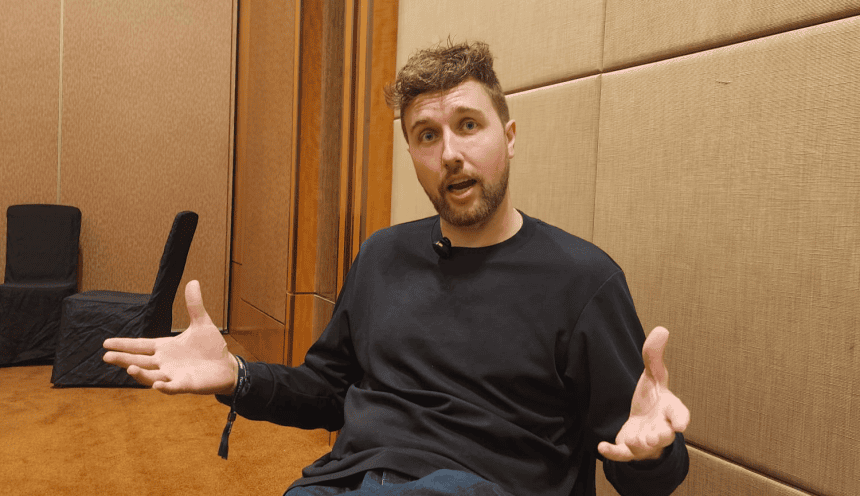
On the sidelines of Token 2049, Blockwind News sat down with Briggs to explore how Intersect is restructuring decentralized capital allocation to fortify Layer-1 infrastructure against quantum computing, establish operational guardrails for autonomous AI commerce, and bridge the divide between public ledgers and enterprise finance.
The Executive Q&A: Jack Briggs
1. Quantum Timelines and Milestone-Gated Treasury Allocations
Joe Pan, Blockwind News: How is Intersect MBO structuring treasury milestones and grant allocations to protect long-term developer initiatives against accelerated quantum threat timelines?
Jack Briggs: I think one of the responsibilities of any technology ecosystem is to invest in its long-term development, particularly as new computing capabilities emerge. Quantum computing is a good example of that. It presents opportunities and challenges across almost every industry, and blockchain is no exception.
Cardano has already taken meaningful steps here. Earlier this year, the community approved approximately 9 million USD for Input Output Research’s 2026 program, which includes dedicated work on post-quantum security.
Importantly, this investment builds on the work of a highly respected research team, whose contributions extend well beyond Cardano itself. IO Research has published more than 250 peer-reviewed papers, attracting over 10,000 academic citations. That demonstrates the value of this work not just to Cardano, but to the advancement of blockchain technology and the wider industry.
The research is looking at how Cardano’s underlying technology can continue to evolve as quantum computing advances, while contributing to the broader understanding of security and decentralized systems.
From Intersect’s perspective, our responsibility is to ensure that funding approved by the community is administered transparently and that delivery is accountable. We do this through agreed milestones, independent oversight, and payments linked to demonstrated progress.
Research is slightly different from traditional development. We shouldn’t expect every investigation to produce an immediate product, but we should expect clear findings, evidence of progress, and practical recommendations.
Ultimately, it’s about giving researchers the time and resources to tackle these complex challenges while ensuring the community can see how its investment is being used.
2. Cryptographic Migration Milestones for Layer-1 Protocols
Blockwind News: What specific cryptographic migration milestones must Layer-1 protocols and consensus layers achieve before quantum and supercomputing advances threaten legacy staking and consensus rails?
Jack Briggs: I think it’s important to put quantum computing into perspective. Its development has implications for virtually every industry that relies on modern cryptography, from traditional banking and telecommunications to government infrastructure and blockchain.
Much like we’re seeing with the rapid advancement of frontier AI models, these technologies present both opportunities and challenges. The responsibility of any industry is to understand those developments and ensure its infrastructure continues to evolve alongside them.
For Cardano, that means investing in research today to understand how advances in computing might influence the security and performance of the network over the longer term.
There are several practical steps involved, from evaluating new cryptographic approaches and understanding where they could be introduced, through to independent testing and eventually coordinating any necessary upgrades across the wider ecosystem.
This is already an area of active investment. Cardano’s community recently approved approximately 32.9 million ADA for Input Output Research’s 2026 program, which includes work on quantum-resistant cryptography and the future development of Ouroboros, Cardano’s underlying consensus protocol.
I think this is one of Cardano’s strengths. Its research-led approach means we’re not simply reacting to emerging technologies, but actively investing in understanding them and preparing for the opportunities and challenges they may bring.
Ultimately, security isn’t a one-time achievement. It’s something that needs to evolve continuously, regardless of the underlying technology.
3. Enforcing Operational Boundaries on Autonomous AI Agents
Blockwind News: How can decentralized identity frameworks and smart contract policy permissions prevent autonomous AI agents from exceeding assigned spending limits or operational boundaries on-chain?
Jack Briggs: I think there’s a significant opportunity for blockchain technology to provide some of the safeguards we’ll need as AI agents become increasingly autonomous.
If we’re going to allow software to make decisions and spend money on our behalf, we need confidence that it can only act within the boundaries we’ve established.
For example, a business might authorize an AI agent to purchase services or pay suppliers, but only up to a certain amount, from approved providers, and for a defined period. Smart contracts can help enforce those restrictions, rather than relying on the AI agent simply following instructions.
Digital identity adds another important layer by helping establish which agent is acting and who has authorized it.
We’re already seeing some interesting developments across the Cardano ecosystem. Masumi is developing infrastructure for AI agents to interact and transact, while Midnight is exploring how privacy technology can help enforce spending limits and other restrictions without exposing sensitive financial or commercial information.
Midnight’s work with partners such as Turnkey is particularly interesting here, as it looks at how businesses could delegate spending authority to AI agents while retaining meaningful controls.
For me, the principle is quite straightforward: AI agents should have enough freedom to be useful, but not so much that we lose accountability or control.
4. Cryptographic Trust and Verification in Machine-to-Machine Commerce
Blockwind News: What cryptographic mechanisms are essential to establish trust and verify machine-to-machine commerce without human intermediaries?
Jack Briggs: I think trust is going to be one of the biggest challenges as we move toward a world where AI agents increasingly transact with one another.
Today, when two businesses work together, there are contracts, identities, payment arrangements, and established ways to resolve disagreements. We need to provide similar assurances when much of that interaction happens automatically between machines.
Blockchain can help by providing a reliable record of transactions, ways to verify identities and permissions, and rules governing when payments can be made.
We’re beginning to see practical examples of this across the Cardano ecosystem. Masumi is developing infrastructure that allows AI agents to discover services, establish identities, and make payments, including arrangements where funds are held until agreed conditions are met.
Midnight brings another interesting dimension through its focus on privacy. For example, an AI agent could potentially demonstrate that it’s authorized to complete a transaction, or that it has stayed within an agreed budget, without publicly revealing the underlying commercial information.
Of course, technology alone doesn’t guarantee that a service has been delivered correctly. There will still be a need for reliable information, safeguards, and clear accountability.
But I think blockchain has a meaningful role to play in establishing the foundations for trusted commerce between autonomous systems.
5. Web3 Self-Regulation and the 1970s DNA Parallel
Blockwind News: How can decentralized Web3 communities enforce effective, ethical self-regulation frameworks for emerging AI technologies without relying on slower, traditional legislative bodies?
Jack Briggs: One of the interesting things about decentralized communities is that they already have mechanisms for making collective decisions and holding participants accountable.
Cardano is a good example of that. Through its on-chain governance system, the community can make decisions about funding, network development, and the standards it expects from projects receiving treasury support.
At Intersect, we help put those decisions into practice. Funding comes with agreed deliverables, reporting requirements, and oversight, with further payments dependent on meeting the relevant conditions.
I think similar principles can be applied to emerging AI technologies. Communities can establish expectations around security, transparency, appropriate use of personal information, and the responsibilities of people operating autonomous systems.
For example, an AI project seeking community funding could be required to demonstrate appropriate security controls, clear spending permissions, and processes for addressing incidents or unintended consequences.
Self-regulation shouldn’t be seen as a replacement for legislation, particularly where consumer protection or wider public interests are concerned. But communities don’t have to wait for governments to establish every standard.
I think we have an opportunity to demonstrate that decentralized governance can be both innovative and responsible.
6. Institutional Standards and Open-Source Collaboration
Blockwind News: Which open-source or institutional self-regulatory entities are best positioned today to set pragmatic global standards for quantum-resistant and agentic technology?
Jack Briggs: I don’t think any single organization can or should determine the standards for technologies that will have such a widespread impact.
For quantum-resistant security, organizations such as the US National Institute of Standards and Technology (NIST) are already playing an important role in evaluating and establishing new cryptographic standards.
For AI, we’re seeing encouraging collaboration through organizations such as the Linux Foundation, its Agentic AI Foundation, and the World Wide Web Consortium, particularly around interoperability, digital identity, and how autonomous systems interact.
But I also think there’s an important role for open-source communities and the organizations developing the technology itself.
Cardano has a longstanding relationship with academic research, and its latest community-funded research program brings together Input Output Research, leading universities, and other specialist contributors.
Through Intersect, we can help connect that research with the wider ecosystem, supporting open discussion, coordination, and the adoption of new standards where appropriate.
For me, the most important thing is that standards are developed openly, tested independently, and remain accessible to everyone. That’s particularly important if we want decentralized technology to remain genuinely decentralized as it matures.
The Operating Reality: Budgeting in Volatility and the Enterprise Horizon
Throughout the Token 2049 discussions, Briggs returned to a fundamental thesis: enduring protocol value is created through infrastructure engineering rather than market cycle timing. Intersect itself operates under an economic model that mirrors the realities of on-chain systems.
“I budget in ADA,” Briggs explained during the interview recording. “My revenues and income that I run this non-profit Intersect with is from the Cardano treasury in ADA. So I have to pay attention to pricing because I’m paying the bills in a volatile currency. It’s challenging, but it’s also a fantastic experience because you start to really see the direct interactions between fiat, different digital assets, stablecoins, and how you can utilize different financial instruments to deliver against an operating budget. But from a speculative perspective? No. I’m glad I’m not in that world. I’m in infrastructure, fundamentally.”
That infrastructure focus also dictates Intersect’s approach to global enterprise adoption. While consumer adoption accelerates across emerging markets such as Latin America—where nations like Argentina readily embrace rapid cycles of technological and governance innovation—institutional deployment in Western financial centers remains constrained by public blockchain transparency.
“Many enterprises and institutions see the value of blockchain technology, but they want it in a private, permissioned way,” Briggs observed. “Public chains like Cardano, Bitcoin, and Ethereum are fully transparent. That’s scary for enterprise compliance officers. This is why privacy-centric networks like Midnight appeal to large institutions. They provide selective disclosure frameworks so institutions don’t have to build complex, isolated infrastructure from scratch.”
As Post-Quantum Day draws closer and autonomous software agents prepare to handle high-frequency capital flows, the dividing line between resilient protocols and obsolete architectures will be determined by capital deployment decisions made today.
“Resilience and security are things we take very seriously at Cardano,” Briggs concluded. “We’re proud of our track record, but you can only stay proud if you maintain it. Complacency comes when you stop focusing on foundational security. That is what Cardano refuses to do.”
- Navigating Cardano’s Voltaire Era: On-Chain Voting and Decentralized Treasury Allocation
- Preparing Layer-1 Blockchains for the Post-Quantum Threat Horizon
- Autonomous Agents and Machine-to-Machine Commerce: The Web3 Identity Frontier
About the Author:
Joe Pan is an editor and producer at Blockwind News and an early adopter of blockchain technology. He has covered major crypto conferences globally since 2019 and moderated Web3 events across Asia. Joe is part of the founding team of Blockwind News and teaches Asia’s only accredited Master of Journalism class on “Covering Cryptocurrency and Blockchain” at Hong Kong Baptist University.
