


30th October, 2026
By Shubhii Verma
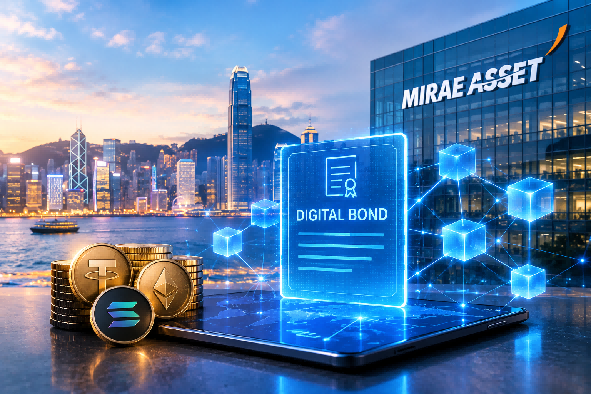
South Korea’s Mirae Asset Securities has issued US$12.5 million in dollar-denominated digital bonds through its Hong Kong subsidiary, using proprietary tokenization technology for the first time, the company announced October 28.
The six-month floating-rate bonds were issued across the Solana and Ethereum blockchain networks. The transaction marks the first time an overseas subsidiary of a South Korean financial institution has issued US dollar digital bonds using an internally developed tokenization system, according to the company.
The issuance builds on a digital bond sale completed by the Hong Kong subsidiary in January, when it relied on technology supplied by an external provider. This transaction used Mirae Asset Securities’ own systems throughout product development, token issuance, settlement, and post-issuance management.
Digital bonds represent bondholders’ rights through tokens recorded on a blockchain. Their infrastructure can make transaction records easier to verify and may automate processes such as interest payments and repayment of principal at maturity. These features could improve bond administration and settlement.
Mirae Asset Securities, a major subsidiary of Mirae Asset Group, said the issuance demonstrates its ability to manage tokenization internally. The company plans to use its experience and international networks to expand its portfolio of tokenized financial products.
Blockwind News ANALYSIS
The $12.5 million issuance is modest in scale, but its operational significance may exceed the headline value. By using its own technology rather than relying on an outside provider, Mirae Asset Securities gains experience across the digital bond lifecycle. That expertise could reduce vendor dependence and refine processes for future offerings.
Using both Solana and Ethereum highlights how financial institutions are exploring multiple blockchain networks. However, operating across chains can introduce technical, security, interoperability, and compliance challenges. Investors should not assume tokenization automatically makes bonds safer, more liquid, or cheaper.
The broader opportunity lies in whether digital issuance can simplify settlement, improve recordkeeping, and attract more investors. Those benefits depend on legal enforceability, reliable custody, clear investor rights, and secondary-market liquidity—not merely recording a bond onchain.
For Hong Kong, the transaction adds momentum to tokenized financial products and the city’s ambition to develop digital-asset markets. Progress will depend on repeat issuance, broader institutional participation, and evidence that the technology delivers tangible efficiencies. For now, Mirae’s move is a practical step toward in-house tokenization, not proof that blockchain bonds have reached mainstream scale. Future issuance, investor participation, and settlement performance will determine its commercial value in practice.
