


27th October, 2026
An exclusive technical Q&A with the cryptography engineer and UC Berkeley grad on securing self-sovereign AI agents and bridging the gap between public ledgers and institutional privacy.
By Joe Pan
SINGAPORE — Across the buzzing halls of Token 2049, the industry’s most pressing conversations have drifted away from speculative tokens and settled firmly on an impending architectural crisis. As decentralized finance scales, the very infrastructure supporting it faces dual existential threats: the accelerated capability of AI agents to exploit legacy smart contracts, and the looming arrival of Post-Quantum Day (Q-Day)—the moment quantum supercomputers shatter the cryptographic primitives that secure public blockchains.
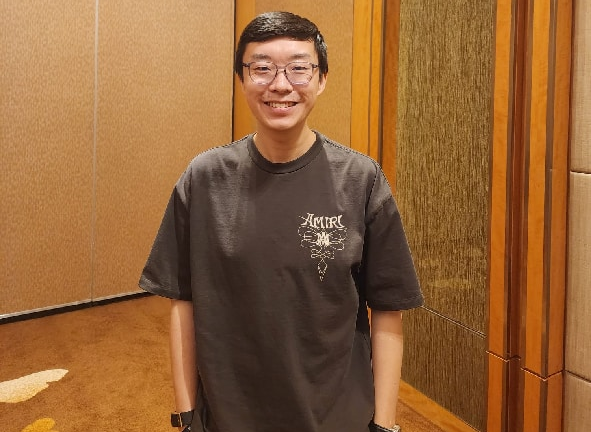
Few are as technically equipped to navigate this collision course as Howard Wu, co-founder and CEO of Provable (formerly Aleo). A cryptographer who studied computer science and applied mathematics at UC Berkeley under the founders of Zcash, Wu has spent the last decade pioneering zero-knowledge proofs (ZKPs). Since 2019, Provable has evolved into a privacy-focused Layer 1, raising over $200 million from heavyweights like SoftBank, a16z, and Tiger Global.
“Agents are starting to break protocols on-chain,” Wu warned, noting that legacy protocols developed before the AI era lack necessary rigor. In response, Provable aggressively integrates formal verification—mathematically proving code is bug-free—through pioneering work with Stanford’s Kestrel Institute. They are also deploying a vertically integrated privacy stack, including the confidential AMM ShieldSwap, protecting institutional trading strategies from predatory on-chain surveillance.
As the industry braces for quantum horizons and autonomous agentic payments, Blockwind News sat down with Wu to explore Provable’s post-quantum roadmap and the mathematical imperatives required to secure the next decade of digital finance.
The Executive Q&A: Howard Wu
1. “Harvest Now, Decrypt Later” & Historical Privacy
Joe Pan, Blockwind News: Does Shor’s algorithm risk retroactive deanonymization of past Shield Wallet or confidential USDC transactions, or is Aleo’s zero-knowledge concealing property information-theoretically post-quantum secure?
Howard Wu: This is an industry-wide challenge, and I think it’s important to be candid about it. As things stand today, essentially every on-chain privacy protocol, including Aleo, the network we built at Provable, relies on cryptography that a sufficiently powerful quantum computer could break using Shor’s algorithm. That means private transactions recorded today could in principle be deanonymised once quantum computers come online. Even in Zcash’s case, not everything is exposed, but certain components absolutely are, and Aleo faces similar issues. Every protocol is now working out how to migrate, and Aleo is no different. We have a roadmap to post-quantum security, which involves upgrading to new primitives for encryption, decryption and signing well before quantum computing becomes a practical threat.
2. Lattice ZKPs & Mobile Prover Latency
Blockwind News: Migrating from elliptic curves to post-quantum alternatives like STARKs or lattice-based SNARKs adds substantial proving overhead. How will post-quantum migration preserve Aleo’s sub-three-second mobile proving benchmark?
Howard Wu: Believe it or not, speed isn’t the problem. The leading post-quantum proof systems are actually faster than the SNARKs we use today. The real challenge is size. The proofs Provable built for Aleo are among the most compact in the industry, at under a kilobyte each, whereas state-of-the-art post-quantum proofs are currently anywhere from 20 to 100 kilobytes. If every transaction carries a proof, that adds up quickly. A chain like Aleo or Solana already grows by one to two terabytes a year, so making each proof 20 to 100 times larger could add tens of terabytes of extra data every year. That’s a big ask of the network.
Looking ahead, I believe hash-based SNARKs are the most likely direction. Lattice-based approaches are also candidates, but I have my own questions about them. Lattices have a very particular mathematical structure, and with the pace of AI research, I think there’s a real chance AI finds ways to exploit it. This is an open debate among cryptographers, and there are good people in both camps, but I’m firmly on the hash-based side.
3. Throughput & Post-Quantum State Bloat
Blockwind News: Post-quantum signatures require kilobytes of data versus ECDSA’s 64 bytes. What architectural mechanisms prevent Layer 1 throughput and validator bandwidth from collapsing under this data expansion?
Howard Wu: Because of how we designed Aleo at Provable, we’re in an unusual position here. On Ethereum, Bitcoin or Solana, every transaction stores a signature. We don’t do that. Instead, we verify the signature inside a zero-knowledge proof and store the proof. So for us, the post-quantum question isn’t about bigger signatures; it’s about bigger proofs.
There are established ways to tackle that. Rollups, for example, take a large batch of transactions and compress them into a single proof. There’s also active research, including our own, into new ways of combining and compressing proofs so that chains don’t need to store as much data. This field is moving fast, and I’m confident we’ll have very tractable solutions well before quantum computers arrive.
4. Circuit Constraint Completeness
Blockwind News: Kestrel verified Aleo’s VM opcodes and consensus, but application-level vulnerabilities typically stem from under-constrained circuits. Can formal verification tooling mathematically prove constraint completeness for arbitrary, third-party smart contracts?
Howard Wu: In the age of AI, yes we can, and candidly, we couldn’t before. Formal verification is an incredible tool for mathematically proving that circuits, algorithms and code do exactly what they’re meant to do. At Provable, we’ve been advocates for years. We started working with Kestrel around seven years ago, well before the rest of the crypto industry caught on, to formally verify the circuits behind Aleo’s VM opcodes and key properties of our consensus design.
Back then, it all had to be written by hand, and proving every part of the system was extremely tedious. Today, AI can help build those verification models far more quickly, which has dramatically increased how much we can verify, and it’s already catching bugs before we ship software. The important distinction is that AI on its own is a bit of a random walk. It’s great at spotting obvious issues, but it can’t give you certainty. For something like a cryptographic protocol, you still need deterministic formal methods to lock in exactly what’s being proven. So my advice is to use AI to build the formal verification, not to replace it. I expect this to become standard practice across the industry.
5. Economic Invariant Verification
Blockwind News: Formal methods prove memory and execution safety, but DeFi exploits often manipulate oracle pricing and liquidity imbalances. How can Provable mathematically verify multi-asset AMMs like ShieldSwap against systemic economic attack vectors?
Howard Wu: This is where a branch of zero-knowledge research called zkTLS comes in. TLS is the security behind HTTPS, the padlock in your browser. zkTLS lets you prove that a piece of data, such as a price, genuinely came from a specific secure website, without having to trust whoever is passing it along. You can then use a zero-knowledge proof to show that those prices were combined correctly, for example as a weighted average using a fixed formula.
That still leaves the risk of someone manipulating the price at the source. The answer there is scale. Most oracles today rely on a handful of feeds, perhaps three. Use a hundred instead, all verified this way, and an attacker would need to move a hundred different markets rather than three. That’s something we’re actively researching at Provable, because it makes for a more honest and fair market.
6. Securing Non-Deterministic MCP Triggers
Blockwind News: ShieldSwap’s MCP enables agents to execute swaps from macroeconomic signals. What cryptographic barrier ensures off-chain LLM prompt injections cannot force malicious on-chain transactions?
Howard Wu: The honest answer is that anyone using AI agents will always be at some risk of prompt injection. No one can make a language model immune to that. What we can do is put strong guardrails around what an agent is allowed to do. That’s why we were very deliberate when we built Shield Wallet MCP, the AI connector Provable recently released for Shield, our confidential finance platform. Users get granular control over exactly what their agent can access: reading balances, getting quotes, sending payments, executing swaps or bridges, switching accounts and more. An agent can be completely read-only, have full access, or anything in between. User security matters enormously to us, and we want people to choose precisely how much power they hand to their AI.
7. Zero-Knowledge Agent Guardrails
Blockwind News: If autonomous agents manage self-sovereign confidential wallets, how can the protocol verify an agent obeyed its execution mandate without forcing developers to publicly expose proprietary trading algorithms or model weights?
Howard Wu: I’m not sure zero-knowledge proofs are necessarily the most efficient tool for this. One of the most promising approaches is trusted execution. Secure enclaves let you run signed software and produce attestations that prove which code actually ran, without making the code itself public. For agents operating in these environments, that gives much stronger guarantees about what functions were called and what software was actually invoked. That said, this is still very early. I haven’t yet seen it used in production, so it’s an area that’s ripe for development and one we’re watching closely at Provable. I’d expect to see ten startups funded to tackle it over the next decade.
The Operating Reality: Defending Against AI and Protecting Asian Capital
Throughout the discussion, Wu repeatedly stressed that human psychology often obscures technical realities. When evaluating the threat of quantum computers cracking ECDSA signatures on networks like Bitcoin, he takes a measured stance.
“Humans tend to overestimate the significance of things in terms of time, but also they tend to underestimate the long-tail risk of things as well,” Wu explained during the interview. While some fearmongers warn of a five-year collapse and conservatives predict twenty, he anchors on a 10-year timeline, noting that “there will be signs… incremental thresholds” such as research chipping away at efficiency before a true black swan event occurs. For legacy chains, he views Bitcoin as the ultimate “canary in the coal mine.”
But while quantum threats are a decade away, AI exploits are here today. “I think it’s going to get worse before it gets better,” Wu warned, highlighting that agents are already writing bug-free code but also learning to exploit pre-AI era protocols.
Beyond security, Provable is laser-focused on practical Asian adoption, particularly shielding large institutional and whale capital from predatory on-chain behavior. “In the APAC region, there is a lot more interest in trading and in exchanges and in financial products,” he observed. “For a lot of those who have large, serious capital or are individual traders… one of the concerns that they have is having their positions be exposed on chain. Liquidation attacks are a very real thing. People look for those wallets, they hunt them and then they try to push them out.”
By deploying zero-knowledge infrastructure, Provable aims to protect these portfolios, ensuring proprietary trading strategies cannot be reverse-engineered or copy-traded. This privacy mandate extends to real-world assets (RWAs), an area where Wu offered a glimpse of Alpha for the region.
“We are preparing to also bring RWA stocks onto ShieldSwap as well,” Wu revealed. “This is the first time that these individuals in Southeast Asia can actually buy stocks confidentially on-chain and hold U.S. securities. That is a very unique opportunity.”
As Provable advances both formal verification and programmable privacy, the endpoint is a radical reimagining of financial autonomy. “What would the world look like if you have agents who are self-sovereign, meaning they have their own wallets, it’s their own money, no one can see the money other than them, and they can have full control and autonomy of themselves?” Wu asked. “What does that imply for the rest of the world and for us as a society? I think that is a very interesting and fascinating question to ask.”
About the Author:
Joe Pan is an editor and producer at Blockwind News and an early adopter of blockchain technology. He has covered major crypto conferences globally since 2019 and moderated Web3 events across Asia. Joe is part of the founding team of Blockwind News and teaches Asia’s only accredited Master of Journalism class on “Covering Cryptocurrency and Blockchain” at Hong Kong Baptist University.
