


28th October, 2026
By Cyrus Tong
On October 20, 2026, Allium and FXC Intelligence published analysis that reframes the APAC stablecoin compliance story in a way that most practitioners have not yet fully absorbed.
The headline finding is precise and striking:
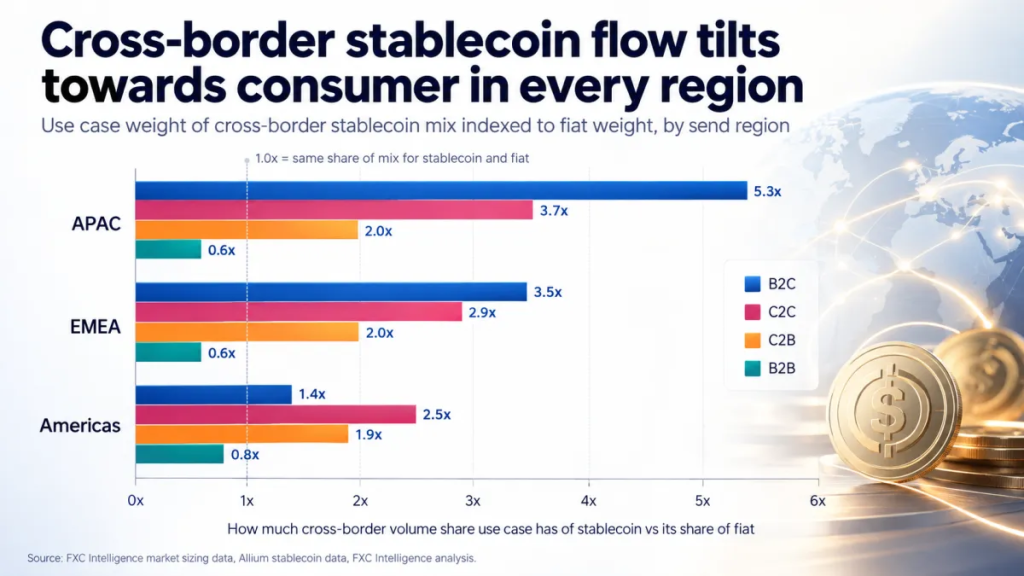
B2C stablecoin payments in Asia-Pacific skew 5.3 times more toward business-to-consumer cross-border flows than equivalent traditional currency transfers.
By comparison, the same metric stands at 3.5 times in EMEA and just 1.4 times in the Americas.
APAC leads the world in B2C stablecoin over-indexing by a margin that demands a compliance response calibrated to that specific payment flow, not to the B2B wholesale narrative that has dominated most institutional discussion of the space.
The Data That Demands a Different Compliance Question
To understand why the 5.3x figure matters, it helps to understand what it is measuring.
The Allium and FXC Intelligence analysis compares stablecoin payment flows against conventional fiat payment flows by category (B2B, B2C, C2B, and C2C), and calculates how much each category over- or under-indexes relative to its fiat equivalent.
An index of 1.0 would mean stablecoins are used for B2C payments at exactly the same rate as fiat.
An index of 5.3 means they are used for B2C payments at more than five times the rate of their fiat equivalent.
B2B, by contrast, under-indexes at between 0.6 and 0.8 times its fiat weight across every region globally.
The category that absorbs the most institutional discussion (wholesale business-to-business settlement, treasury management, correspondent banking replacement) is actually the category where stablecoin adoption is most lagging behind fiat in relative terms.
The category where APAC stablecoin adoption is most dramatically ahead of fiat is B2C.
And B2C means one thing specifically: a business is sending funds to an individual.
Payroll. Gig economy disbursements. Contractor payments. Platform payouts.
Refunds at scale. Insurance disbursements.
These are the flows that stablecoins in APAC are serving at 5.3 times the rate of fiat equivalents, and they carry a compliance surface that is categorically different from the institutional counterparty frameworks that most stablecoin compliance architecture has been designed around.
Why APAC Leads and What It Signals
The 5.3x figure is not accidental.
It reflects structural features of the APAC payment landscape that create genuine commercial demand for stablecoin B2C infrastructure.
APAC accounts for 45 percent of stablecoin payment outflows and 45 percent of inflows, a near-perfect balance that suggests a largely self-contained regional payment ecosystem rather than primarily a corridor to Western financial systems.
And 84 percent of stablecoin payment volume occurred within the same geographic region, not cross-border, a finding that directly challenges the framing of stablecoins as primarily a cross-border payment solution in this region.
Within APAC, the structural drivers of B2C dominance are clear.
Digital platform economies in Southeast Asia, South Asia, and Northeast Asia have created massive B2C payment flows (platform disbursements to gig workers, marketplace payouts to sellers, digital service refunds, cross-border freelancer payments) that traditional fiat infrastructure handles expensively, slowly, and with significant friction at the point of individual recipient verification.
Stablecoins resolve all three of those problems simultaneously.
C2C penetration (consumer to consumer) is already approaching 0.95 percent of the cross-border market, close to crossing 1 percent in 2026. B2C sits at 0.89 percent.
Both are growing significantly faster than B2B, which sits at 0.19 percent penetration.
The retail and platform economy segments are leading institutional adoption in APAC, not following it.
The Compliance Architecture Gap This Creates
Here is where the 5.3x finding creates its most significant compliance challenge.
Most stablecoin compliance frameworks currently being built, and most of the regulatory guidance being issued, are calibrated primarily to the B2B institutional use case.
The GENIUS Act’s reserve and AML requirements are written for permitted payment stablecoin issuers operating in institutional payment flows.
MiCA’s governance standards are built around financial institution counterparties.
The HKMA’s stablecoin framework focuses on institutional-grade reserve management and redemption obligations.
These are appropriate frameworks for the institutional issuance model.
But they do not directly address the compliance challenge that the 5.3x B2C figure creates, which is the large-scale verification, monitoring, and reporting obligations that attach to stablecoin flows directed to individual recipients across multiple jurisdictions simultaneously.
B2C stablecoin flows in APAC typically involve a regulated business sending to an individual whose identity must be verified, whose transaction purpose must be assessed, and whose receiving wallet must be screened against sanctions and financial crime watchlists.
When that flow happens at the scale of a platform economy (thousands of disbursements per day, across multiple jurisdictions, to individuals with varying levels of documentation), the transaction monitoring architecture required is fundamentally different from the counterparty due diligence framework built for B2B institutional settlement.
- The B2C disbursement model requires KYC at the individual recipient level at scale, a capability most institutional compliance frameworks have not been built to deliver efficiently.
- The cross-jurisdictional nature of APAC B2C flows creates layered regulatory obligations. Each recipient jurisdiction may have its own AML, data protection, and consumer protection requirements that attach to the disbursement
- The 84 percent intra-regional volume means the compliance obligations are primarily in-market, not cross-border, changing the regulatory authority and framework that governs each transaction.
My Take
I have spent years building compliance frameworks across APAC payment corridors, at PingPong, at Livi Bank, at TNG, and now at DCS FinTech Group.
And the 5.3x finding confirms something that practitioners in this region have known experientially but that the data has not previously captured with this precision.
The stablecoin compliance challenge in APAC is not primarily a wholesale institutional challenge.
It is a retail and platform economy challenge.
One that requires compliance infrastructure designed for high-volume, lower-value, individual-recipient payment flows rather than the institutional counterparty frameworks that most regulatory guidance has been written to govern.
The institutions building stablecoin infrastructure in APAC that are calibrating their compliance architecture exclusively to the B2B institutional model are building for the segment that under-indexes at 0.6 to 0.8 times its fiat weight.
They are not building for the segment that over-indexes at 5.3 times.
The data now makes that mismatch visible.
The compliance architecture that closes it is the work ahead.
About the author
Cyrus Tong, an award-winning compliance expert, is the Group Chief Compliance Officer of DCS Group.
