


14th September 2026
By Joe Pan
Follow-up to: Taiwan “Crypto Congressman” Calls for 0.1% of GDP as Bitcoin Strategic Reserves
A Renewal Call for Strategic Bitcoin Reserve
When Taiwan legislator (立法委員) Dr. Ju-Chun “JC” Ko (葛如鈞) first proposed allocating 0.1% of Taiwan’s GDP (roughly US$600 million to US$700 million) into a sovereign Bitcoin strategic reserve in early 2025, conventional financial circles greeted the idea with skepticism. Central bankers pointed to volatility, regulatory voids, and custody risks, while government departments treated seized digital assets as administrative burdens to be auctioned off as quickly as possible.
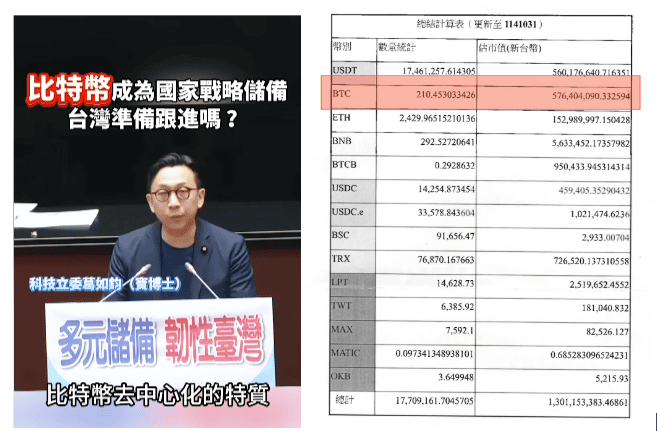
Eighteen months later, the landscape in Taipei has shifted dramatically. Following intense parliamentary inquiries led by Ko, the Ministry of Justice (法務部) conducted Taiwan’s first comprehensive digital asset audit, revealing that judicial and law enforcement authorities hold over 210 Bitcoins (valued at approximately NT$570 million), placing Taiwan 8th globally in confirmed government-held Bitcoin reserves, according to CoinGecko tracking data cited in legislative records.
More importantly, Taiwan’s legislature (立法院) recently passed the landmark Virtual Asset Service Act (VASA), which transitioned Taiwan from a basic anti-money laundering registration system to a comprehensive licensing and prudential regime. Embedded within the legislative intent and explanatory notes of Article 47 is a crucial shift: a legal presumption for in-kind preservation of seized digital assets. Instead of liquidating confiscated Bitcoin immediately by default, judicial authorities now possess a statutory mandate to custody assets in kind until legal claims are settled.
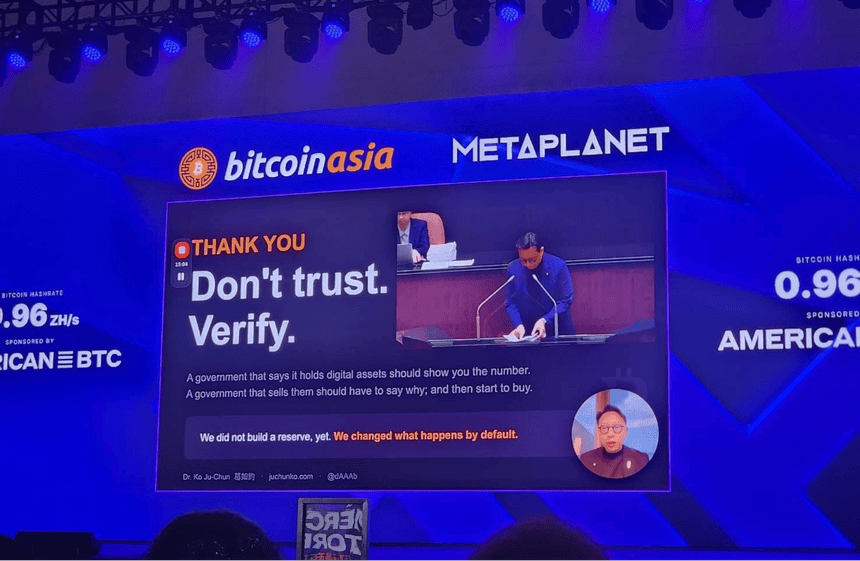
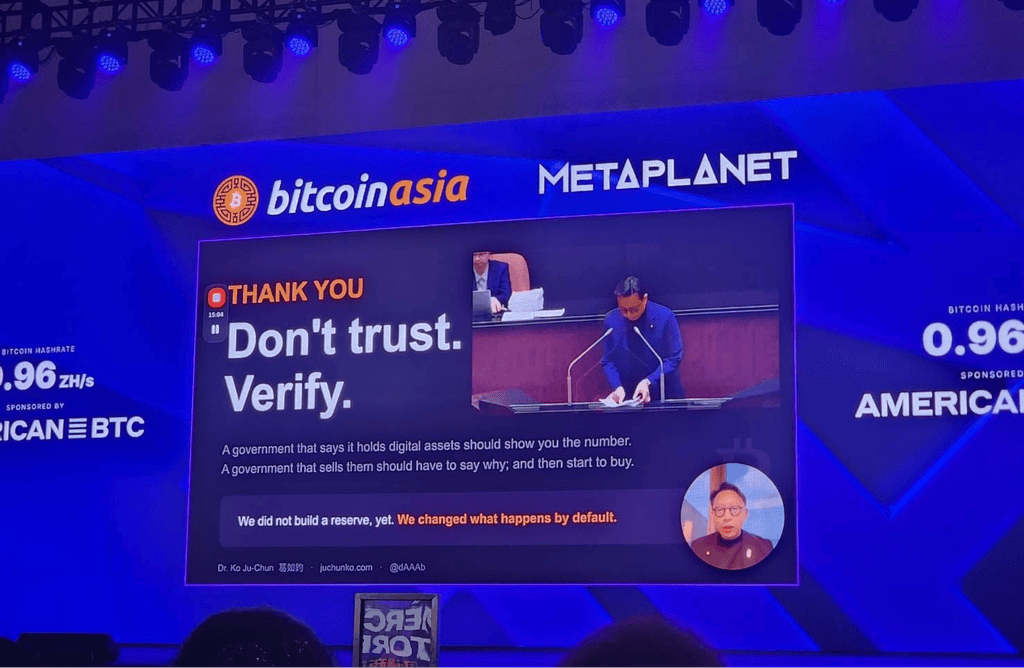
Addressing the Bitcoin Asia Conference 2026 in Hong Kong via a virtual keynote, Dr. Ko articulated what he calls the pragmatic “order of operations” for sovereign adoption: doing the “boring work” of inventory, multi-signature custody, and statutory default rules before rushing into buying sprees. Below is an updated analysis of Taiwan’s digital reserve roadmap, accompanied by an in-depth Q&A with Dr. JC Ko.
Q&A: Dr. JC Ko on Building Taiwan’s Bitcoin Reserve Rails
Question 1: Next Steps, Political Feasibility, and Custodial Readiness
What is the immediate next concrete legislative or executive step in your push for a strategic Bitcoin reserve? Realistically, do you expect the current administration under Premier (行政院院長) Cho Jung-tai (卓榮泰) and Central Bank Governor (中央銀行總裁) Yang Chin-long (楊金龍) to move forward with a formal reserve mechanism? Why or why not?
Furthermore, would the state’s setup, hardware security modules, and multisig insurance costs outweigh the benefits, and does the Taiwanese civil service currently possess the specialized personnel and technical infrastructure to manage sovereign cryptographic keys safely?
Dr. JC Ko: My next priority is a governmentwide custody and preservation plan, with a clear timetable and accountable agencies. I want an updated inventory that separates assets still under seizure, assets due to victims, and assets finally forfeited to the state. The published inventory of more than 210 Bitcoins was dated Oct. 31, 2025. It should not be presented as a current, freely available Bitcoin reserve.
I would press the Executive Yuan (行政院) to coordinate the relevant agencies and submit an initial plan. That is my proposed deadline. The plan should cover custody standards, staffing, costs, and the legal changes needed for a reserve pilot.
My assessment is that a limited custody pilot is more politically achievable than an immediate large purchase. The Central Bank (中央銀行)’s December 2025 report presents a cautious stance, yet it also identifies the Czech Republic as a positive case for the first time, which is a promising development. I cannot promise that the administration will approve a formal reserve, but caution should lead to testing with clear milestones, rather than an open-ended delay.
I would not claim that every agency is already ready. We need an independent capability review, recovery drills, and competitive cost estimates. HSMs, multisignature controls, and insurance are different safeguards; insurance exclusions matter as much as premiums. Since the state already holds digital assets, some custody costs exist regardless of reserve policy. Shared infrastructure and a small pilot can test whether the additional cost is justified.
I continue to support evaluating a Bitcoin allocation equivalent to 0.1% of GDP. That is a policy target for study, subject to legal authority, budget review, and risk limits—not an instruction to buy the full amount tomorrow.
Question 2: Geopolitical Resilience and National Defense Scenarios
In your parliamentary statements and discussions with the Bitcoin Policy Institute, you have framed Bitcoin not as a speculative investment, but as a component of national defense and financial sovereignty. How exactly would a sovereign Bitcoin reserve function in an extreme geopolitical crisis — such as a naval blockade, financial embargo, or subsea telecommunications cable severance — compared to Taiwan’s conventional foreign exchange reserves and physical gold?
Dr. JC Ko: For me, financial resilience means keeping more lawful options available when normal systems are under stress. A carefully managed Bitcoin holding could add one such option. It would complement our existing reserves, not replace them.
Foreign currency and government bonds remain central to import payments, liquidity, and exchange-rate stability. Physical gold has no issuer, but moving it can be difficult during a blockade. Bitcoin can be held under direct key control and transferred without physically shipping the asset or relying on one correspondent bank. Its usefulness still depends on counterparties willing and legally able to accept it, as well as available liquidity.
A cable outage exposes an important limit. A transaction can be signed offline, but it must reach the Bitcoin network to be confirmed. If all external communications are lost, Bitcoin cannot provide immediate cross-border settlement. We would need tested backup communications, resilient power, and a workable authorization process.
Bitcoin also cannot move food or fuel through a physical blockade, guarantee a stable price, or make a payment exempt from applicable law. In a market panic, it may fall sharply just when funds are needed.
That is why I support a limited allocation and realistic crisis exercises. The goal is to reduce dependence on any single financial channel and build practical options before an emergency. We should judge those options by how they perform under stress, not by a promise that one asset can solve every crisis.

Question 3: Inter-Agency Reconciliation (Central Bank (中央銀行) vs. Ministry of Justice (法務部))
There appears to be an institutional divergence: the Ministry of Justice (法務部) has historically treated seized digital assets as criminal evidence to be quickly auctioned for fiat currency, while the Central Bank (中央銀行) views crypto assets as volatile commodities outside traditional foreign reserves. How does the in-kind preservation principle under Article 47 of the Virtual Asset Service Act resolve this tension, and what specific statutory mechanism can govern the custody of confiscated assets going forward?
The price and volatility of Bitcoin in recent months have shown that it may not be the best time to enter the market now. Given this, what is your view on timing, and when do you suggest the best time for the Central Bank to buy more?
Dr. JC Ko: These agencies have different legal duties, so I would not reduce the issue to a simple dispute over whether Bitcoin is good or bad. My contribution has been to challenge the assumption that digital assets should routinely be converted into cash.
The original-form principle appears in the legislative explanation to Article 47. It offers an interpretive basis, alongside applicable law, for officials to preserve the asset and delay unnecessary sales where legally permitted. It does not impose a blanket sales ban or itself establish a reserve. Supplementary Resolution No. 13, which I co-proposed, asks agencies to review preservation, return, and exceptional sale procedures.
My proposed next step is a common custody framework with case-level records, separate asset categories, approval requirements, and documented reasons for any sale. It must respect court orders and victims’ rights. Further legislation should address any gaps in authority for long-term state holdings. Assets due to victims cannot become government reserves simply because they are Bitcoin.
On timing, I would first correct the phrase “buy more”: assets held through judicial proceedings do not establish that the Central Bank (中央銀行) has already bought Bitcoin. I do not claim to know the market bottom. Retaining eligible assets already owned by the state and purchasing new assets are separate decisions.
Once custody, legal authority, and a risk budget are in place, I support evaluating phased purchases under published rules. My 0.1%-of-GDP proposal remains a scale for assessment. Price volatility is a reason to control exposure; it should not become a permanent excuse to avoid building the capability.
Question 4: Stablecoins, Tokenized Treasuries, and Reserve Architecture
Beyond Bitcoin, you have also advocated evaluating U.S. dollar-pegged stablecoins and tokenized sovereign debt for Taiwan’s trade and treasury management. How do fully backed stablecoins and tokenized assets fit alongside Bitcoin in your broader reserve and financial defense hierarchy?
Dr. JC Ko: I would give each asset a clear job. Conventional reserve assets remain the foundation for liquidity and monetary stability. Regulated, fully backed stablecoins can be evaluated as tools for payments and settlement. Tokenized government debt can be evaluated for cash management and collateral. Bitcoin is a candidate for a limited long-term strategic holding.
A dollar stablecoin extends access to the dollar system; it does not remove dependence on that system. Full backing does not eliminate issuer, redemption, bank, or legal risk. Some issuers can freeze tokens or block addresses, as Circle’s USDC terms explicitly provide. That matters when assessing crisis use.
Tokenizing a government bond changes how a claim is recorded and transferred. It does not remove the underlying issuer’s credit risk. We must also ask whether the holder owns a direct bond claim, a fund interest, or a claim against an intermediary, and what happens if the platform fails.
My proposal is to test these tools in limited, lawful use cases with banks and trade participants. We should measure settlement time, total cost, redemption reliability, and recovery from outages. Whether any instrument qualifies as an official reserve asset is a separate legal and accounting question.
The wider opportunity is to connect Taiwan’s businesses to useful digital financial infrastructure. Public policy should make that possible with clear rules, while keeping payment tools, investment products, and strategic holdings distinct.
Question 5: Preventing Key Mismanagement and Institutional Corruption
Several foreign governments that seized substantial amounts of cryptocurrency have suffered from misplaced private keys, insider embezzlement, or operational mismanagement. What concrete cryptographic checks and balances—such as M-of-N multi-signature schemes, time-locked contracts, or independent proof-of-reserves audits—must Taiwan mandate before any state-managed digital asset holdings are expanded?
Dr. JC Ko: My core requirement is that no single official, agency, or contractor should be able to move public assets alone. Technical safeguards must match legal responsibility.
First, I support independently reviewed threshold authorization. A 3-of-5 multisignature arrangement is one possible design, not a universal answer. Signers must be separated across genuinely independent roles and locations. Five keys controlled by the same person do not provide meaningful separation. Bitcoin supports transactions requiring multiple signatures.
Second, keys should be generated and held in hardened environments, with offline signing where appropriate, protected backups, and tested recovery procedures. We need regular drills for lost devices, unavailable signers, compromised keys, and staff changes.
Third, transactions need destination checks, limits, independent review, and alerts. Timelocks may help some designs, but they must not prevent lawful victim restitution or an emergency response. Any emergency path must still require independent authorization and leave a complete audit trail.
Fourth, independent audits must reconcile on-chain balances with case records, ownership, victim claims, and any other obligations. Proof of reserves alone does not prove that the state owns every coin or that every liability has been disclosed. Public reporting should be meaningful without exposing private keys, sensitive security details, or victims’ identities.
Finally, I would require procurement transparency, conflict-of-interest declarations, incident reporting, and clear legal limits on lending or pledging the assets. A secure wallet cannot compensate for weak public governance. These controls should be tested before holdings are expanded.
Question 6: Taiwan’s Strategic Timing in the Global Sovereign Race
With the United States debating legislative proposals for a Strategic Bitcoin Reserve, and nations such as El Salvador, Bhutan, and the UAE actively holding sovereign digital assets, where does Taiwan rank in urgency? Can Taiwan afford to take a wait-and-see approach, or does delaying action risk forfeiting early-mover geopolitical and economic advantages?
Dr. JC Ko: Taiwan should act now to build capability. That does not require treating every foreign headline as a reason for an immediate purchase.
One premise needs updating: the United States moved beyond legislative debate when a March 6, 2025 executive order established a Strategic Bitcoin Reserve framework based on eligible, finally forfeited Bitcoin. That is distinct from a law requiring large new purchases. The Czech National Bank also offers a practical example: in November 2025 it launched a small digital-asset test portfolio, separate from its international reserves, to learn about custody and operations.
International comparisons must separate central-bank reserves, treasury holdings, sovereign investment vehicles, and judicial custody. I would not treat a headline about the UAE, or a commercial holding linked to a country, as proof of a federal Bitcoin reserve without clear official evidence. These are different legal arrangements, not one reliable league table.
For Taiwan, the most urgent task is to turn our existing custody experience into a tested institution. We should update the inventory, preserve eligible assets where lawful, complete independent custody tests, and put a reserve pilot before public and legislative scrutiny.
Waiting has costs: lost experience, delayed standards, and fewer opportunities for local financial and technology firms. Those costs exist even if Bitcoin’s price falls. I want Taiwan to help develop trusted custody, payment, and tokenization services—not simply watch others set the rules. My position is to begin the institutional work now, with limited exposure and clear accountability.
About the Author
Joe Pan is an editor and producer at Blockwind News and an early adopter of blockchain technology. He has covered major crypto conferences globally since 2019 and moderated Web3 events across Asia. Joe is part of the founding team of Blockwind News and teaches Asia’s only accredited Master of Journalism class on “Covering Cryptocurrency and Blockchain” at Hong Kong Baptist University.
References & Official Sources
- Office of Ju-Chun Ko (葛如鈞國會辦公室) — Bitcoin reserve initiative and published custody inventory
- Central Bank (中央銀行) of the Republic of China (Taiwan) — Written response, December 2025
- Bitcoin Developer Guide — P2P Network
- Virtual Asset Service Act — Article 47 explanation and Supplementary Resolution 13
- Circle — USDC Terms
- Bitcoin Developer Guide — Transactions and multisignature scripts
- The White House — Strategic Bitcoin Reserve executive order, March 6, 2025
- Czech National Bank — Digital Assets Pilot
