


8th September 2026
By Shubhii Verma
The next great fight over AI may not be about who creates the best content. It may be about proving where that content came from.
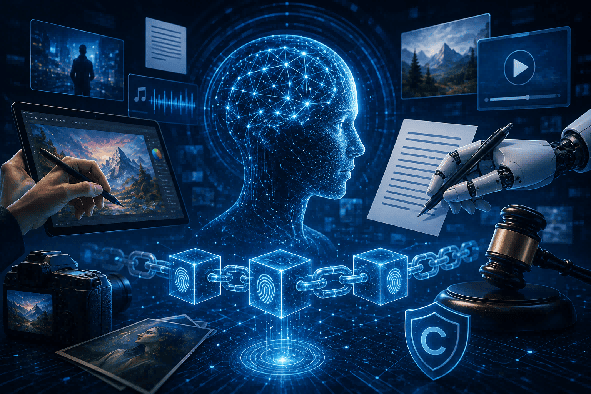
A photograph can be transformed by an AI model, a journalist’s reporting can become part of a chatbot’s answer, and an artist’s work can influence an image that looks entirely new. As AI-generated text, images, music and video become increasingly difficult to distinguish from human work, the digital world faces a fundamental problem: how do we establish a trustworthy history for something that may have been created by dozens of unseen human and machine contributions?
The answer could determine who gets credit, who gets paid, and who is responsible when copyright disputes arise.
What Is AI Content Provenance and Why Does It Matter?
For creators, the value is accountability. A verifiable record could make it easier to establish when a work existed, who created it, how it was modified, and which permissions applied. For AI companies, provenance could provide a framework for documenting training data and demonstrating that content was obtained under appropriate terms. For platforms, it could become a way to distinguish authenticated creative material from manipulated or falsely attributed content.
Cryptographic provenance offers one possible foundation. Standards such as C2PA’s Content Credentials attach digitally signed records to digital assets, documenting their origin, edits and tools involved in their creation. Cryptographic hashes bind the record to the content, making unauthorized changes detectable. C2PA also supports “soft bindings,” including invisible watermarks and fingerprints, which can help reconnect provenance information when metadata is separated from a file.
That makes provenance more useful than a simple “AI-generated” label. Imagine an image that begins as a photograph, is edited by a human, passes through an AI model, receives further retouching, and is finally published by a news organization. A provenance record could preserve that chain.
Why AI Training Data Attribution Is Still Difficult
Yet this solves only part of the problem. Knowing that AI touched an image does not reveal which training materials influenced the model. Attribution of training data is considerably harder because modern models learn patterns from enormous datasets without maintaining a simple source-to-output map. A developer may know what entered training while being unable to prove that a particular photograph contributed a measurable percentage to a specific generated image.
That distinction matters enormously for copyright. The U.S. Copyright Office has said AI-assisted works can receive copyright protection when sufficient human creativity determines the expressive elements, while prompts alone generally do not provide enough human authorship. At the same time, questions surrounding the use of copyrighted material to train generative-AI systems remain unresolved.
AI Copyright Lawsuits Are Raising the Stakes
Those questions are increasingly moving from policy debates into courtrooms. In July 2026, a $1.5 billion copyright settlement involving Anthropic, authors, and publishers received final approval. Days later, Sony Music Publishing and Warner Chappell sued Anthropic over alleged unauthorized use of copyrighted songs for model training.
These disputes show why provenance needs to operate at multiple levels. A blockchain record could timestamp a work, record its cryptographic hash, and document licensing transactions. But blockchain cannot determine whether the person registering a work actually owns it, nor can it prove that a training dataset was lawfully acquired. “Garbage in, immutable garbage out” remains a fundamental problem.
Watermarking has a different strength. An invisible mark can travel with content when ordinary metadata is stripped. But watermarks can potentially be attacked or removed, and content may never have been watermarked in the first place. Blockchain provides durable records, while watermarking can help reconnect those records with files. A credible system may therefore require both.
Could Decentralized Registries Track AI Models, Datasets and Creative Works?
The bigger opportunity is a decentralized registry for models, datasets and creative works. Each asset could receive a persistent identifier, provenance record, licensing terms, and usage conditions. A model could declare which datasets it is authorized to use. A creator could specify whether commercial AI training is permitted and at what price. Platforms could query the registry before ingesting content, while auditors could verify historical claims.
This could also create a mechanism for micropayments. If a photographer licenses a collection for AI training, smart contracts could potentially distribute small payments when authorized usage occurs. A model developer might pay according to dataset size, inference volume or commercial revenue. Music, journalism, stock photography and specialist datasets could become licensable inputs rather than invisible raw material.
The technical challenge is measuring contribution fairly. If millions of works train a model, assigning a precise royalty to every creator is extraordinarily difficult. Influence is not the same as inclusion, and a model’s output may reflect statistical patterns rather than identifiable copying. Any payment system would require attribution rules, reliable usage records, and mechanisms for resolving disputes.
Why Platforms Will Be Critical to AI Content Provenance
Platforms will be crucial. Social networks, search engines, cloud providers and digital marketplaces can preserve, display or strip provenance information. AI companies control training pipelines and model documentation, while creators control individual works. None can build a universal provenance system alone.
The emerging battle is therefore not simply between AI and copyright. It is about who controls the history of digital creation. AI companies want scalable access to data and workable legal rules. Creators want attribution, consent and compensation. Platforms want systems that are inexpensive, interoperable and resistant to manipulation.
A credible chain of provenance will probably not be a single blockchain, watermark or detection algorithm. It will be a layered system combining cryptographic signatures, durable identifiers, provenance standards, licensing registries, platform support and legal enforcement.
The ultimate goal is simple: make AI’s creative history visible.
If that infrastructure succeeds, the internet could move toward a model where creative contribution remains trackable even when creation becomes a collaboration between humans and machines. Provenance could become the foundation for a new era of digital trust — and potentially a new market for creative rights.
