


24th September 2026
By Shubhii Verma
A photographer uploads a portfolio. A journalist publishes an investigation. A musician releases a song. A scientist builds a valuable dataset. Then an AI model learns from it.
Inside a training corpus containing billions of files, that work may become part of the machinery behind an AI model. The creator may never know it happened.
That creates one of generative AI’s biggest unresolved questions: if human creativity becomes training material for machines generating commercial value, who gets paid?
The industry has debated whether AI training constitutes fair use or copyright infringement. A parallel question is emerging: can creators license their work to AI companies and receive compensation?
Blockchain enthusiasts believe it can. The reality is complicated.
Blockchain’s Big Promise
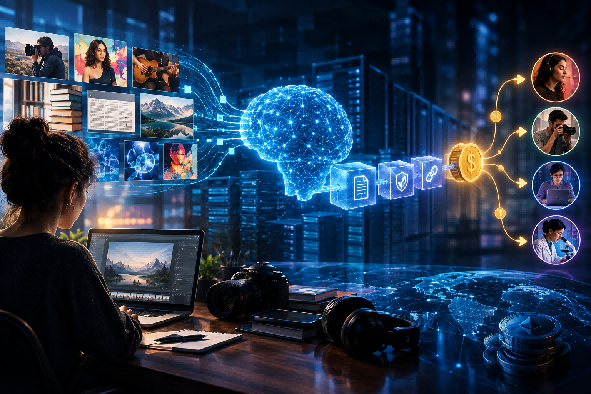
At first glance, blockchain appears suited to the problem. Blockchain can create an auditable record of transactions. Combined with cryptographic provenance, digital identities and smart contracts, it could record ownership, permitted uses, licenses and payments.
C2PA’s Content Credentials already provide cryptographically verifiable provenance for digital assets, recording information about origin and subsequent changes. Projects such as Numbers Protocol are developing infrastructure around digital ownership, provenance and licensing, while Story Protocol is building programmable intellectual-property systems capable of encoding licensing and royalty arrangements.
The goal is to make intellectual property understandable to machines.
But there is a limitation.
A blockchain can record a transaction. It cannot record one that never happened.
If an AI company scraped a million photographs without registering them, creating blockchain records afterward does not prove those photographs entered its training data.
The Attribution Problem
Foundation models can be trained on enormous collections of text, images, audio, video and scientific datasets. Files may be duplicated or transformed before training.
Once training occurs, connecting an individual work to the resulting model can become extremely difficult.
That creates a crucial distinction between provenance and proof of use.
Provenance can establish that a photographer created an image, while a license can establish permission. Neither necessarily proves that the image trained a particular model or determines its economic contribution.
Blockchain can make records difficult to alter. It cannot solve that attribution puzzle by itself.
Would Creators License Their Work?
Shutterstock has developed AI-training licensing arrangements and compensation mechanisms for contributors. In music, rights holders and technology companies are negotiating agreements covering AI-generated covers, remixes and other uses.
The emerging divide may therefore be less about AI versus creators and more about uncompensated AI versus licensed AI.
For creators, licensing could turn AI into a revenue channel. For AI companies, licensed data could offer clearer rights and better training material.
But licensing billions of individual works would be expensive.
Could Micropayments Change the Equation?
Blockchain becomes more interesting when transactions are tiny and frequent.
An AI agent could identify a dataset, check its machine-readable license, pay a small amount in stablecoins and record the transaction before accessing it.
Royalties could then flow automatically across millions of transactions.
For a single creator, each payment might be tiny. Across enormous volumes of content, however, those payments could become meaningful.
The harder question is determining what was used and what it was worth.
Will AI Companies Participate?
Mandatory licensing could alter AI economics. If every training item carried a price, developers would face new costs for identification, negotiation and compliance. AI companies have therefore pursued opt-out systems, legal defenses, partnerships and licensing deals.
Regulators are increasing pressure as well. The European Union’s AI framework requires general-purpose AI providers to maintain copyright-compliance policies and provide information about training content.
The direction is becoming clearer: access to high-quality data is becoming an economic and regulatory issue.
The Missing Number
Even if universal licensing became possible, one problem would remain: how much is a creator’s contribution worth?
Suppose a model trains on 10 million photographs and one photographer contributes 50. Should payment depend on quantity, popularity, uniqueness or measurable influence?
There is no universally accepted answer.
A blockchain can automatically distribute money according to rules. It cannot decide what those rules should be.
Beyond Blockchain
The future is unlikely to be “blockchain replaces copyright.”
Several technologies could work together. Cryptographic provenance could establish ownership. Registries could communicate licensing preferences. AI companies could maintain auditable training records. Smart contracts could encode commercial terms. Stablecoins could enable automated micropayments.
Creators must identify their work. AI companies must provide enough transparency to establish usage. Platforms must recognize licensing signals. Regulators must create standards that make agreements enforceable.
Without those pieces, blockchain risks becoming an immaculate ledger describing an incomplete reality.
The Real Fight Is About Control
The central question is not simply whether blockchain can make AI pay creators.
It is whether creators can gain enough control over their work to negotiate with the machines consuming it.
Generative AI has transformed human knowledge and creativity into an economic resource, while the companies building models control the infrastructure. Creators may own the underlying material but often lack visibility into where it goes.
A functioning provenance-and-payment system could change that balance. It would not make every artist rich whenever an AI generates an image. It could make creative work visible, negotiable, and potentially compensable.
Blockchain may provide the rails.
The harder challenge is proving what machines learned.
