


13th August 2026
By Shubhii Verma
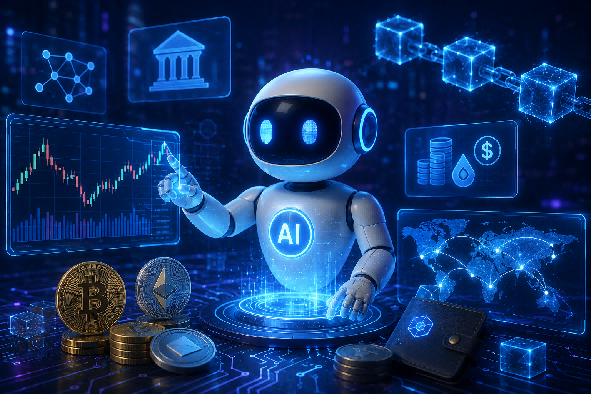
Artificial intelligence and blockchain are increasingly converging to create a new category of software: AI agents that can understand goals, make decisions, and interact with blockchain networks autonomously.
Unlike conventional chatbots, AI agents are designed to perform multi-step tasks. They can interpret information, use external tools, monitor changing conditions, and, when properly authorised, execute transactions or interact with smart contracts. Blockchain provides the infrastructure for recording those actions, managing digital assets, and enforcing predetermined rules.
Research published in 2026 has identified hundreds of AI-agent projects across decentralised finance, trading, portfolio management, governance, communities, and other applications, highlighting how quickly the sector is expanding.
The combination could ultimately create an internet where software is not merely helping people use financial applications but can also act as an economic participant.
What are AI agents in blockchain?
An AI agent is software capable of pursuing a defined objective through a series of decisions and actions. In a blockchain environment, an agent may read on-chain information, analyse external data, interact with decentralised applications and submit transactions through an authorised wallet.
The important distinction is between AI reasoning and blockchain execution.
AI models are generally better suited to interpreting information and deciding what should happen next. Blockchains, meanwhile, are useful for transparent settlement, ownership records and deterministic execution through smart contracts.
A typical architecture could therefore look like this:
AI agent → data and tools → decision → transaction intent → policy checks → blockchain → verifiable settlement
This does not mean the AI itself needs to run entirely on-chain. In fact, keeping complex AI reasoning off-chain while using blockchain for identity, payments, permissions and records can be more practical.
Why blockchain is important for AI agents
AI agents face a fundamental problem: if software can independently make decisions, how does it establish identity, access resources and pay for them?
Traditional online infrastructure was largely designed around humans and businesses. Blockchain introduces several features that could make machine-to-machine interaction easier.
First is programmable money. An agent could potentially pay another agent or service using digital assets without requiring a human to manually approve every small transaction.
Second is verifiable ownership. A blockchain wallet can provide an address through which an authorised agent interacts with digital assets.
Third is transparent settlement. Transactions can create an auditable record of what happened.
Fourth is smart-contract automation. Once predetermined conditions are satisfied, a smart contract can execute an outcome without requiring another intermediary.
Recent research into an emerging concept called “agent-to-agent finance” argues that autonomous agents will require infrastructure covering identity, authorisation, payments, reputation, and accountability. Blockchain-based wallets, registries, and programmable settlement could provide parts of that infrastructure.
Major use cases
1. DeFi automation
Decentralised finance is one of the most obvious areas for agentic systems.
An AI agent can monitor large amounts of market and blockchain data, evaluate predefined objectives, and coordinate activities across multiple protocols. Instead of a user manually checking numerous applications, an agent could potentially manage a workflow based on authorised rules.
Academic research has already mapped AI agents across DeFi applications, including trading, portfolio management, and governance.
The key opportunity is not simply faster transactions. It is automating complex decision-making workflows that currently require significant human attention.
2. Treasury and payment management
Businesses could eventually use agents to monitor cash positions, reconcile transactions and coordinate authorised payments.
For example, an enterprise agent could identify an invoice, verify relevant information, check internal payment policies and prepare a transaction for approval or execute it within predefined limits.
Stablecoins and tokenised deposits could make this particularly interesting because blockchain-based settlement can operate across traditional banking hours and geographic boundaries.
The broader concept is an economy in which software agents can purchase computing power, data, APIs and other digital services directly.
3. DAO governance
Decentralised autonomous organisations generate large volumes of governance information. AI agents can help analyse proposals, historical discussions and blockchain data before producing recommendations.
Research published on agentic DAO governance has explored AI systems that independently interpret proposals and generate voting decisions in simulated environments.
This could make governance more accessible, but it also raises an important question: should an AI agent have voting power over a community’s treasury?
That question moves the discussion from technology into governance and accountability.
4. Blockchain cybersecurity and monitoring
Agents could continuously monitor smart contracts, wallets, and blockchain activity for unusual behaviour.
Instead of waiting for humans to inspect thousands of transactions, an AI system could flag anomalies and initiate predefined defensive procedures.
However, this is also one of the areas where safeguards are particularly important. AI agents with access to financial systems can introduce new attack surfaces, including compromised credentials, malicious instructions, and manipulation of the data an agent relies upon.
Researchers studying autonomous agents on blockchains have identified risks ranging from prompt injection and key compromise to adversarial execution and multi-agent collusion.
5. Agent-to-agent commerce
Perhaps the most transformative possibility is an economy where AI agents transact directly with one another.
Imagine one agent needing computing resources and another agent providing them. Instead of a person negotiating a subscription, the agents could discover available services, compare terms, establish an agreement, and settle payment through programmable infrastructure.
Research into blockchain-based “agent economies” argues that blockchain could provide autonomous agents with identity, asset ownership, and machine-to-machine payments.
This could create an entirely new digital market where software becomes both consumer and producer.
The challenges
The biggest obstacle is not whether an AI agent can send a blockchain transaction. It is whether people can safely allow it to do so.
Blockchain transactions can be difficult or impossible to reverse. AI systems, meanwhile, are probabilistic and can misunderstand instructions.
This creates a fundamental tension:
AI is flexible; blockchains are unforgiving.
An agent could misinterpret a user’s objective, rely on inaccurate information, or interact with a malicious contract. Giving an agent unrestricted access to digital assets would therefore create significant risks.
Identity and permissions are another challenge. Systems need to distinguish between what an agent is allowed to do and what it merely thinks it should do.
Scalability is also important. If millions of agents begin interacting simultaneously, blockchain networks will need to handle much larger volumes of machine-generated activity.
Finally, regulation remains unresolved. If an autonomous agent makes a financial decision, who is responsible for the outcome—the developer, owner, operator, or infrastructure provider?
The road ahead
The next phase of blockchain development may therefore be less about humans interacting with blockchains and more about software interacting with blockchains on behalf of humans and businesses.
The most realistic near-term model is likely to involve bounded autonomy. Agents will receive limited permissions, transaction limits, predefined objectives, and monitoring systems rather than unrestricted control.
Over time, standards for machine identity, transaction intents, reputation, permissions, and auditability could become as important as today’s wallet and smart-contract standards.
The broader opportunity is substantial. Blockchain gives AI agents a potential economic infrastructure for identity, ownership, payments, and settlement, while AI gives blockchain systems a decision-making layer capable of navigating complex information.
Neither technology solves all of the other’s problems. But together, they could create a new form of digital infrastructure in which autonomous software can coordinate economic activity at machine speed.The central question for the crypto industry is no longer simply whether AI agents will use blockchains. It is how much economic authority society will be willing to give them—and what safeguards will be required when software becomes an active participant in the financial system.
