


1st September 2026
By Anjali Kochhar
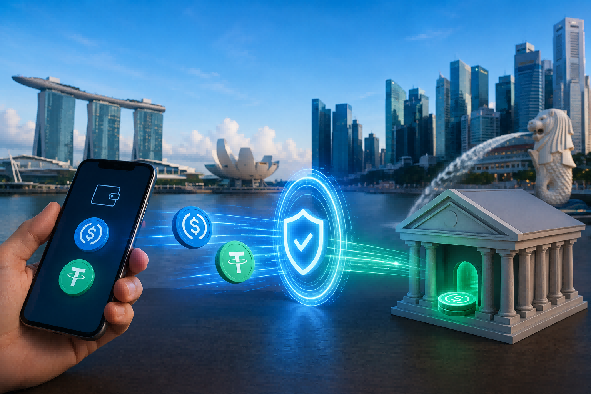
Paying for products and services in Singapore is no longer limited to cards, bank apps and traditional QR payments. A growing number of customers can now pay using stablecoins such as USDC and USDT, while merchants can receive Singapore dollars without having to hold cryptocurrency.
Crypto In, Singapore Dollars Out
The fact that retailers do not have to start cryptocurrency businesses is one of the main benefits of stablecoin payments.
In Singapore, this concept is already taking shape. About 20,000 Singaporean SMEs were able to take stablecoins, including as USDC, USDT, and PayPal USD, thanks to a cooperation announced in October 2025 by digital payment startup Triple-A and payment processor HitPay. Instead of maintaining the digital assets, merchants might get paid in Singapore dollars.
This is significant because it lessens vulnerability to fluctuations in bitcoin prices. The merchant can accept SGD almost like a conventional payment, but the buyer can pay in USDC.
USDC and USDT Are Entering Everyday Payments
Circle’s USDC has been used more and more for financial settlement and payments. Tether’s USDT is still one of the most popular stablecoins in the world.
Additionally, they are becoming more integrated into Singapore’s current payment system.
In September 2025, OKX Pay, in collaboration with Grab and StraitsX, launched a service that enables Singaporeans to utilize SGQR to spend USDC and USDT at GrabPay retailers.
The important part of this development is that the customer and merchant do not have to use the same currency. The customer can pay with a stablecoin, while the merchant receives Singapore dollars.
For businesses considering USDC or USDT payments in Singapore, this separation makes crypto payments considerably easier to adopt.
Payment Providers Handle the Complexity
Most businesses do not need to build their own blockchain payment systems.
Payment gateways can provide the infrastructure required to generate payment requests, connect wallets, verify transactions, calculate exchange rates and settle funds.
Companies such as Triple-A and Independent Reserve offer business-focused services involving stablecoin payments and settlement.
However, businesses should look beyond simply checking which cryptocurrencies a provider supports. They should consider supported blockchain networks, transaction speeds, processing fees, exchange rates, settlement periods, refunds, accounting and compliance.
The right infrastructure can make stablecoin payments feel almost like another traditional payment method.
Regulation Remains Important
Singapore has approached digital assets thoughtfully.
In 2023, the Monetary Authority of Singapore (MAS) published its stablecoin regulations. Qualified single-currency stablecoins issued in Singapore and connected to either the Singapore dollar or a G10 currency are part of the framework. It covers capital, redemption, reserve, and transparency standards.
Nevertheless, this particular paradigm does not apply to all stablecoin transactions. Depending on how a company and its supplier conduct business, digital payment token activities may be subject to Singapore’s more general payment services rules.
Therefore, before using stablecoin payments, businesses must be aware of their regulatory obligations.
KYC, anti-money laundering, sanctions screening, transaction monitoring, and record keeping may all have various requirements depending on the structure.
While stablecoins can be used for ordinary purchases, their real potential lies in cross-border payments.
International payments may entail numerous banks, intermediaries, currency conversions, and settlement delays. Blockchain-based payments may function around the clock and transfer funds across compatible wallets and payment systems.
Singapore is a key hub for international trade, finance, technology, and services, therefore this is especially relevant.
For example, a consumer from another country could pay a Singaporean company in USDC. A payment provider might then convert the funds into SGD, allowing the business to operate in their preferred currency without having to deal with cryptocurrency directly.
Stablecoins are also being considered for supplier payments, payroll, corporate treasury, and international settlement.
This could make them valuable not only for customer payments but also for business-to-business transactions.
What Businesses Should Consider
Companies considering stablecoin payments should first ask whether their customers actually need this option.
The proposition may be particularly attractive to businesses serving international customers, crypto-native users or companies already operating with digital assets.
Businesses must then decide whether to accept stablecoins directly or work through a payment provider.
Direct wallet payments can provide more control, but they also place responsibility for wallet security, transaction verification, network selection and reconciliation on the business.
A payment provider can simplify these processes and automatically convert USDC or USDT into SGD.
Before adopting the system, businesses should carefully evaluate transaction fees, exchange rates, settlement times, refunds, accounting treatment, compliance and security.
The Bigger Picture
Singapore’s stablecoin story is increasingly about infrastructure rather than speculation.
The country is building stronger connections between stablecoins, wallets, payment providers, QR systems and traditional banking. This allows businesses to offer crypto-based payments without completely changing how they manage their finances.
Customer pays with USDC or USDT → Payment provider processes and converts the transaction → Merchant receives SGD.
To succeed, stablecoins don’t have to take the place of bank transfers, cards, or QR payments. Alternatively, they can function as an alternative within Singapore’s already sophisticated digital payment infrastructure.
Solving particular issues, such as international settlement, cross-border payments, and transactions involving digital-native clients, may yield the greatest benefits for firms.
Stablecoins may eventually transition from being a crypto-market product to a useful part of Singapore’s larger payment system if the legislative framework and supporting infrastructure continue to develop.
