


26th August 2026
By Shubhii Verma
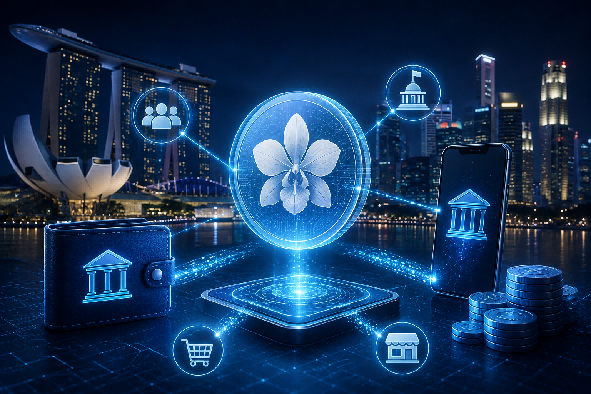
Money is becoming increasingly digital, but Singapore is exploring a concept that could make digital money more than just an electronic version of cash. Through Project Orchid Singapore, the Monetary Authority of Singapore (MAS) has been studying how money could carry conditions that determine where, when, and how it can be used.
At the centre of this research is Purpose Bound Money (PBM), a model designed to combine digital money with programmable conditions. Rather than creating a completely new type of currency, PBM can place a programmable layer around existing digital forms of money, potentially including tokenised bank deposits, stablecoins and future central bank digital currencies (CBDCs).
What Is Project Orchid Singapore?
Project Orchid is a MAS-led initiative exploring the technology and infrastructure required for programmable digital Singapore dollars. The project was launched to develop practical capabilities that could support a retail CBDC if Singapore eventually decides one is necessary.
Importantly, MAS has not committed to launching a retail CBDC. Instead, the project focuses on understanding what programmable money could accomplish and how such systems could work across different financial infrastructures. MAS’s research has also examined interoperability between digital currencies, tokenised deposits and regulated stablecoins.
This approach makes Project Orchid different from a simple CBDC experiment. Its focus is not only on creating digital currency but also on understanding how programmable money in Singapore could improve payments, government disbursements, and commercial transactions.
What Is Purpose-Bound Money?
Purpose Bound Money, or PBM, is the central concept developed through Project Orchid. In simple terms, purpose-bound money means digital money that is accompanied by conditions defining its intended use. For example, a government could distribute a digital voucher that can only be spent at participating merchants and remains valid for a specific period.
The important distinction is that PBM does not necessarily require the underlying money itself to be permanently programmed. Instead, a separate programmable layer or “wrapper” can specify the conditions under which the underlying digital money is released or transferred. MAS designed PBM to work with different forms of digital money and ledger technologies.
This could allow the same underlying digital money to remain interoperable while adding rules around specific transactions.
How Does PBM Singapore Work?
The basic mechanism can be understood through a simple example. Imagine the Singapore government wants to distribute a S$100 digital voucher to households. Instead of giving recipients unrestricted digital money, it could issue a PBM voucher containing conditions.
The conditions could specify:
- Who can receive the money
- Which merchants can accept it
- What types of goods or services qualify
- When the voucher expires
- When the underlying funds are released
When a consumer makes an eligible purchase, the conditions are checked, and the underlying digital money can be transferred to the merchant.
This model can reduce manual verification and reconciliation because parts of the payment process can be handled automatically through programmable infrastructure.
Project Orchid’s Real-World Applications
Singapore has already tested several potential applications for PBM. One of the best-known experiments involved government vouchers. In 2022, DBS and Singapore’s Open Government Products launched a live pilot using tokenised Singapore dollars and smart contracts to create PBM-based vouchers. The system was designed to allow issuers to program how vouchers were distributed and used.
The pilot also explored instant merchant settlement. Instead of merchants waiting for traditional voucher reconciliation and reimbursement processes, eligible transactions could trigger immediate settlement of the underlying digital Singapore dollar.
MAS’s broader Project Orchid research identified several potential applications, including government vouchers, commercial vouchers, government payouts and grants to training providers.
Programmable Money vs Traditional Digital Payments
Most digital money today is programmable only at the payment instruction level. A user can schedule a transfer, set up recurring payments, or use an app to send money, but the money itself generally does not carry conditions after it has been transferred.
Programmable money changes this model by allowing rules to accompany the digital value. For example, a company could potentially issue funds that are released only when a specific milestone is completed. A government could distribute assistance that is restricted to approved categories. A sustainability programme could potentially direct funds toward qualifying activities.
This could improve automation, transparency, and accountability while reducing administrative costs.
Why Does Purpose-Bound Money Matter?
The potential advantage of PBM is that it could connect money, rules, and settlement within a single digital process.
For governments, this could make targeted subsidies, vouchers, and grants easier to administer. For businesses, it could reduce reconciliation and improve cash-flow management. For consumers, it could make digital vouchers and targeted benefits easier to use.
PBM could also become useful in areas such as conditional trade payments, donations, sustainability financing, and property transactions. DBS has highlighted these as potential applications for programmable money.
At the same time, Singapore’s model is designed to avoid fragmenting money into isolated forms that cannot easily circulate. MAS has emphasized preserving the “singleness” of money and ensuring that programmability does not undermine money’s role as a common medium of exchange.
The Future of Programmable Money Singapore
MAS Project Orchid represents an important experiment in the future of digital finance. Rather than immediately launching a retail CBDC, Singapore has focused on building the technology, standards and practical knowledge needed for programmable digital money.
The broader vision is an ecosystem where tokenised deposits, regulated stablecoins and potentially CBDCs can interact through common programmable infrastructure.
For now, PBM Singapore is primarily an experimental and infrastructure concept rather than a new currency used across the country. But Project Orchid demonstrates how digital money could eventually become more intelligent, conditional, and automated.
As governments and financial institutions continue exploring tokenisation, Singapore’s purpose-bound money model could offer a blueprint for using programmable payments while retaining the stability and interoperability expected from regulated money.
