


June 03, 2026
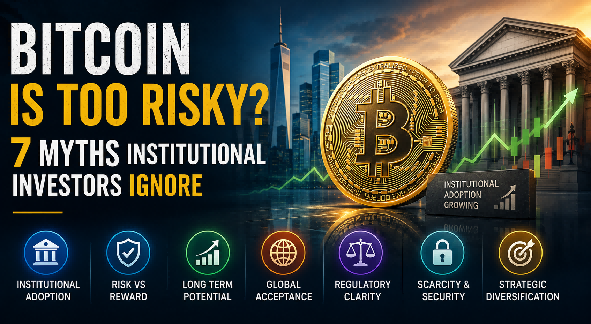
- Myth 1: Bitcoin Has No Institutional Support
- Myth 2: Bitcoin Is Too Volatile for Long-Term Investment
- Myth 3: Bitcoin Has No Real-World Utility
- Myth 4: Regulation Will Destroy the Crypto Industry
- Myth 5: Bitcoin Is Only for Traders and Speculators
- Myth 6: Bitcoin’s Growth Story Is Already Finished
- Myth 7: The Risk Outweighs the Reward
By Anjali Kochhar
For years, Bitcoin was dismissed by traditional investors as a dangerous speculative bubble with no real financial future. Critics warned that cryptocurrencies were too volatile, unregulated, and unpredictable to ever become part of mainstream investing.
But in 2026, that narrative is rapidly changing.
Today, some of the world’s largest financial institutions are investing billions into Bitcoin-related products, while hedge funds, pension managers, and multinational corporations are quietly increasing exposure to digital assets. What was once considered a fringe experiment is now becoming one of the most closely watched sectors in global finance.
As Bitcoin trades near historic highs and institutional demand continues growing, analysts say many investors still misunderstand the real balance between crypto risk and reward.
Here are seven major myths institutional investors are increasingly ignoring.
Myth 1: Bitcoin Has No Institutional Support
This myth may have been true several years ago, but not anymore.
Today, institutional capital is one of the biggest forces driving Bitcoin markets. Companies including BlackRock, Fidelity, and Grayscale have expanded Bitcoin ETF offerings, attracting billions in investor capital.
According to multiple market reports, Bitcoin ETF inflows accelerated again in 2026, helping BTC recover above $73,000.
Research firms say Bitcoin pricing power is increasingly shifting from retail traders to institutional investors.
Even traditional banks such as Morgan Stanley, Goldman Sachs, and Citi are now offering crypto-related services, including trading, custody, and lending.
Myth 2: Bitcoin Is Too Volatile for Long-Term Investment
Bitcoin’s volatility remains one of the biggest concerns among traditional investors. The cryptocurrency has experienced multiple dramatic crashes over the past decade, including declines of more than 70%.
However, institutional investors increasingly argue that volatility alone does not define an asset’s long-term value.
Technology stocks such as Amazon and Tesla also experienced extreme volatility during their growth years before eventually becoming major components of institutional portfolios.
Financial analysts note that Bitcoin’s volatility has gradually declined as market liquidity improves and institutional ownership increases. The expansion of regulated ETFs and derivatives markets has also reduced some of the instability that dominated earlier crypto cycles.
For many portfolio managers, Bitcoin is now viewed similarly to a high-growth emerging technology asset rather than purely speculative gambling.
Myth 3: Bitcoin Has No Real-World Utility
Another common criticism is that Bitcoin lacks practical use beyond speculation.
But blockchain technology is increasingly influencing global financial systems.
Banks and financial institutions are now experimenting with tokenized assets, blockchain settlements, decentralized payment rails, and smart contract infrastructure. Governments are also exploring central bank digital currencies (CBDCs) built using blockchain-related technologies.
Meanwhile, Bitcoin itself continues strengthening its reputation as “digital gold” — a decentralized store of value that cannot be controlled by governments or central banks.
Supporters argue that Bitcoin’s limited supply of 21 million coins gives it long-term scarcity value similar to precious metals.
Myth 4: Regulation Will Destroy the Crypto Industry
Regulation was once viewed as one of the biggest threats facing cryptocurrencies.
But in 2026, clearer regulatory frameworks are actually helping institutional adoption grow.
The United States, European Union, United Kingdom, UAE, and several Asian economies are developing more structured crypto regulations aimed at improving investor protection and market transparency.
Analysts say institutional capital typically avoids unregulated markets. As governments create clearer rules for digital assets, large investment firms are becoming more comfortable participating in crypto markets.
Instead of destroying Bitcoin, regulation may be accelerating mainstream acceptance.
Myth 5: Bitcoin Is Only for Traders and Speculators
Retail investors often associate Bitcoin with short-term trading and social media hype.
Institutional investors, however, increasingly approach Bitcoin as a strategic long-term allocation.
Some wealth managers now recommend small Bitcoin exposure within diversified portfolios as protection against inflation, currency debasement, and geopolitical uncertainty.
As global debt levels rise and central banks continue managing inflation pressures, Bitcoin’s appeal as an alternative financial asset is growing among macro investors.
Myth 6: Bitcoin’s Growth Story Is Already Finished
Skeptics argue that Bitcoin’s biggest gains already happened years ago.
Yet many institutional analysts believe global crypto adoption is still in its early stages.
Only a small percentage of global wealth is currently invested in digital assets compared with stocks, bonds, or real estate. Supporters argue that if institutional adoption continues expanding, Bitcoin could still experience significant long-term growth over the next decade.
Growing ETF demand, limited supply issuance, and rising corporate treasury adoption continue strengthening bullish sentiment across crypto markets.
Myth 7: The Risk Outweighs the Reward
There is no denying that Bitcoin carries substantial risk.
Prices remain highly sensitive to macroeconomic events, interest rate changes, geopolitical tensions, and regulatory developments. Sudden market crashes remain possible, and crypto markets can still experience sharp corrections within short periods.
However, institutional investors increasingly evaluate Bitcoin using a broader risk-versus-reward framework.
For many portfolio managers, the bigger risk may now be completely ignoring digital assets during what some analysts describe as a major transformation in global finance.
Even small portfolio allocations to Bitcoin may offer asymmetric upside if blockchain technology and decentralized finance continue expanding worldwide.
The Bigger Picture
Bitcoin remains one of the world’s most debated financial assets. Critics continue warning about volatility and speculation, while supporters believe cryptocurrencies represent the next evolution of money and finance.
But one trend is becoming increasingly clear: institutional investors are no longer treating Bitcoin as a temporary trend.
Instead, they are treating it as a serious asset class that could reshape investment strategies, payment systems, and global financial infrastructure over the coming decade.
Whether Bitcoin ultimately fulfills those expectations remains uncertain. Yet in boardrooms, hedge funds, and investment banks across the world, the conversation has already changed.
The question is no longer whether Bitcoin is risky.The real question may be whether the global financial system can afford to ignore it.
