

27th November, 2026
By Anjali Kochhar
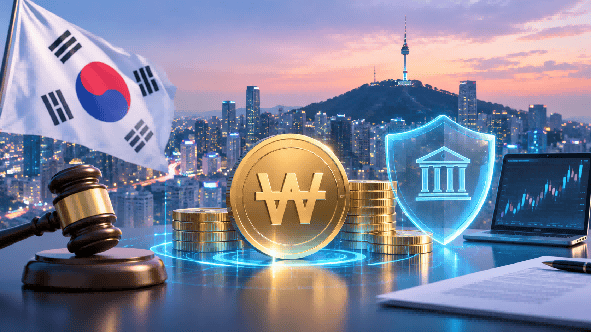
South Korea is moving towards a more structured digital finance ecosystem with proposed regulations that would enable domestic banks to issue stablecoins and potentially reverse the country’s nine-year ban on initial coin offerings (ICOs).
The Financial Services Commission (FSC) unveiled the draft regulatory framework on November 24, 2026, as part of a broader initiative to encourage financial innovation, improve market transparency and strengthen investor protection. The proposed legislation remains subject to approval by the National Assembly.
Banks and Fintech Firms to Drive Stablecoin Adoption
Under the proposed framework, stablecoin issuance would initially be restricted to consortiums in which domestic banks collectively hold a majority ownership stake. However, fintech companies and technology providers would also be permitted to participate.
The approach seeks to combine the regulatory experience of traditional financial institutions with the technological capabilities of emerging fintech businesses.
Stablecoin issuers would be required to maintain reserves equivalent to at least 100% of their outstanding tokens and ensure timely redemption. These safeguards could help establish greater confidence in digital payment instruments while reducing financial stability risks.
The development could create new opportunities across digital payments, blockchain-enabled settlements and financial infrastructure.
South Korea Considers Reopening Token-Based Fundraising
Another significant component of the proposed legislation is the potential return of domestic initial coin offerings.
South Korea prohibited ICOs in 2017 amid growing concerns surrounding fraudulent fundraising activities and investor losses.
Under the revised framework, businesses seeking to raise capital through digital tokens would be required to submit detailed documentation outlining their business objectives, fundraising targets, associated risks and intended utilisation of proceeds.
The disclosure requirements would introduce greater accountability into token-based fundraising, bringing certain practices closer to conventional capital market standards.
Stronger Oversight of Digital Asset Platforms
The proposed legislation also introduces ownership restrictions for digital asset trading platforms. Major shareholders would generally be limited to a 20% ownership stake, with exceptions permitting holdings of up to 34% following regulatory approval.
These measures aim to strengthen platform neutrality, improve corporate governance and prevent excessive ownership concentration. Additional provisions address operator liability for losses arising from cybersecurity breaches and system failures.
Implications for the Fintech Industry
South Korea’s regulatory shift reflects a broader effort to integrate emerging financial technologies into established banking and payment systems.
If approved, the framework could encourage greater collaboration between banks, fintech startups and technology companies while opening alternative financing channels for digital businesses.
Rather than maintaining blanket restrictions, South Korea appears to be pursuing a supervised innovation model that balances technological advancement with financial security.
The final legislation will be crucial in determining how the country positions itself within the rapidly evolving global digital finance economy.
