


29th September 2026
By Anjali Kochhar
Chinese manufacturers and infrastructure firms are shifting their attention to the United States, where the construction of AI data centres has left China far behind, CNBC has reported.
Brightray, a Singapore-registered AI infrastructure company that relies entirely on Chinese manufacturer PrefabDC, says American demand now outpaces what it sees in China, though the home market still matters.
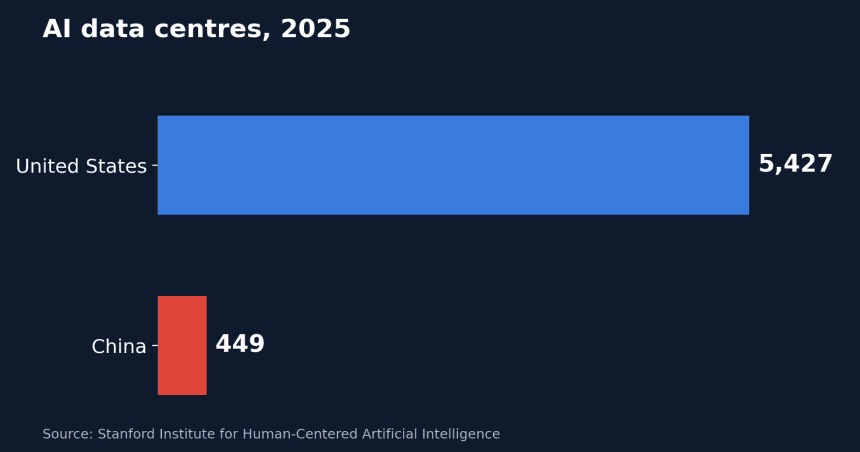
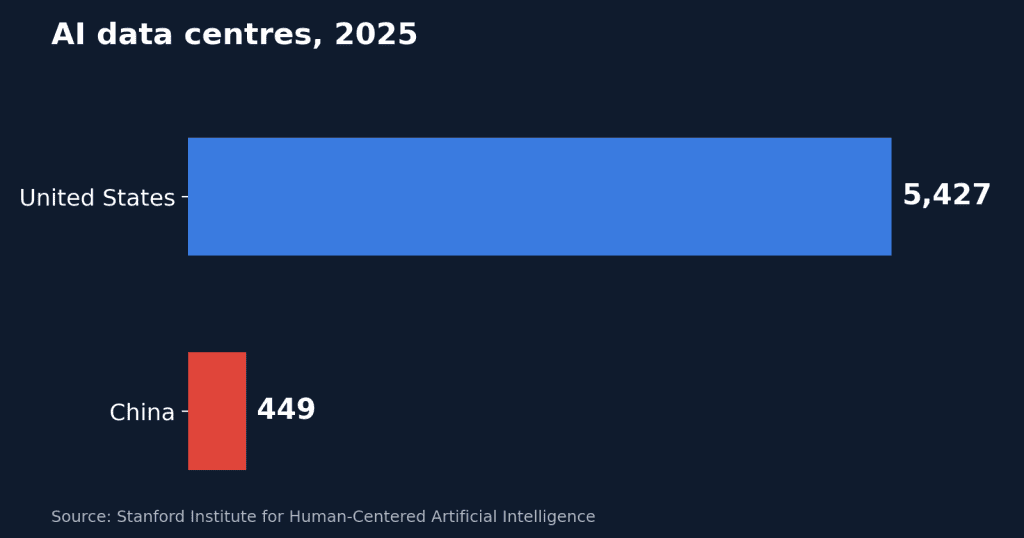
The numbers explain the pull. Stanford’s Institute for Human-Centered Artificial Intelligence counts 5,427 AI data centres in the US in 2025, against just 449 in China. Alphabet, Microsoft, Meta and Amazon together are expected to pour roughly $765 billion into AI infrastructure this year, and JPMorgan Chase chief Jamie Dimon has said the figure could touch $1 trillion next year.
Why the US Is Outspending China on AI Infrastructure
Chinese players such as Alibaba are spending far less, even as Beijing lays out plans to invest $295 billion in data centres over the next five years. Jeffrey Ding, an assistant professor at The George Washington University who studies AI, puts it down to revenue: Chinese companies simply aren’t earning enough from AI services to fund expansion on the American scale.
Supply chains versus security concerns
Talks on AI between Chinese President Xi Jinping and US President Donald Trump during Xi’s Washington visit have put the commercial relationship back in focus. Politics, however, remains the biggest hurdle. Lawmakers in Washington are wary of cybersecurity risks and of leaning on China for critical infrastructure, and the Trump administration is weighing bans on Chinese open-weight AI models as well as more categories of Chinese data centre components.
Chinese Manufacturing Remains Hard to Replace
Cutting the cord won’t be easy. Benjamin Boucher, principal analyst at Wood Mackenzie, says the US still doesn’t produce enough of essentials such as electrical equipment, and long waiting periods make Chinese sourcing hard to ignore. American data centres already depend on Chinese-made transformers, batteries and fibre-optic cables.
Brightray sees China’s tightly knit manufacturing base as its edge. At its Yangzhou factory, much of the material and equipment comes from within China because suppliers are close at hand. The company claims its prefabricated data centres, built with PrefabDC, can halve construction time in the US, where projects typically take two to three years.The pushback in Washington is already taking shape. A bipartisan bill seeks to keep Chinese-made optical transceivers out of sensitive federal systems, citing risks to AI data centre and government communications hardware. Industry voices have cautioned that sidelining major Chinese suppliers could disrupt supply chains and slow America’s AI build-out, since domestic alternatives may not yet be able to meet demand at scale.
