


25th June 2026
By Shubhii Verma
Indian Exchanges Expand Into Tokenised Stocks of Tesla, Apple, and Nvidia
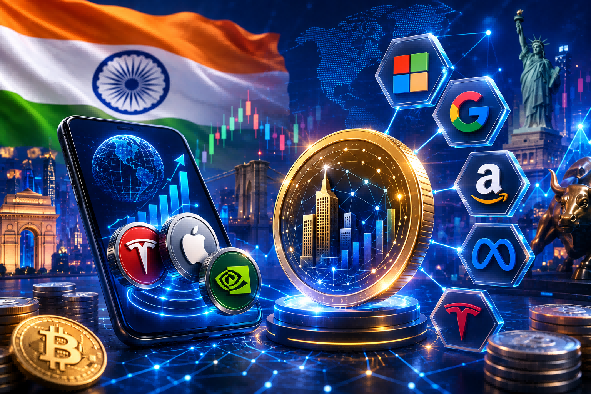
Indian crypto exchanges are increasingly turning to tokenised real-world assets (RWAs) as they look beyond traditional cryptocurrency trading for future growth. Over the past several months, platforms such as CoinSwitch, Mudrex, and Bybit have expanded their offerings to include tokenised stocks, giving Indian retail investors access to global companies through blockchain-based investment products.
The trend reflects a broader shift in the digital asset industry. Globally, the tokenised RWA market has surpassed $10 billion in market capitalization, according to Binance Research, representing a tenfold increase from approximately $1 billion in early 2024. The sector includes tokenised equities, commodities, exchange-traded funds (ETFs), and other traditional financial assets that are represented and traded on blockchain networks.
Among the most popular offerings on Indian platforms are tokenised shares of major U.S. technology companies, including Nvidia, Tesla, Apple, Amazon, Alphabet, Meta, and Microsoft. These products allow investors to purchase fractional exposure to high-value stocks without needing to buy an entire share.
Fractional Ownership, Stablecoin Settlement, and the Business Case for RWAs
Industry leaders say accessibility is one of the primary drivers behind the growing interest. By enabling fractional ownership, tokenisation lowers investment barriers and allows retail investors to participate in global markets with relatively small amounts of capital. Instead of purchasing a full share worth thousands of rupees, investors can buy a fraction of the asset according to their budget.
Mudrex founder and CEO Edul Patel believes tokenised assets could eventually become the company’s primary business focus, surpassing traditional crypto trading. He points to recent regulatory developments in the United States, including the passage of the GENIUS Act and progress on the proposed Clarity Act, as factors helping to improve confidence in digital asset infrastructure and stablecoin-based financial products.
Tokenised stocks are generally purchased using stablecoins and mirror the price movements of the underlying shares. Investors gain economic exposure to the stock while ownership records are maintained on blockchain networks rather than through conventional brokerage systems.
India’s Regulatory Landscape, SpaceX Lessons, and the Global Tokenisation Outlook
Legal experts note that tokenised stocks would likely be treated as virtual digital assets (VDAs) under India’s current regulatory framework, making them subject to the country’s existing digital asset tax rules. However, industry participants believe policymakers may eventually introduce more tailored regulations as the market matures.
Interest in tokenised assets surged further during recent attempts to offer tokenised access to the highly anticipated SpaceX IPO. Exchanges including CoinSwitch and Bybit launched pre-IPO token offerings that attracted significant retail attention. Although the initiative ultimately failed because exchanges were unable to secure actual IPO allocations, industry observers described the setback as an infrastructure issue rather than a failure of blockchain technology.
Despite the challenges, global exchanges remain optimistic about the future of tokenised capital markets. With major companies such as OpenAI, Anthropic, and other high-profile technology firms potentially preparing for public listings, tokenised investment products are expected to play an increasingly important role in expanding retail access to global financial opportunities.
